 The Strength Years
Nutrition
Protein after 50: a practical starting point
Not a target to hit for the rest of your life. A way of finding out what you actually eat, and a short list of things that reliably fix it.
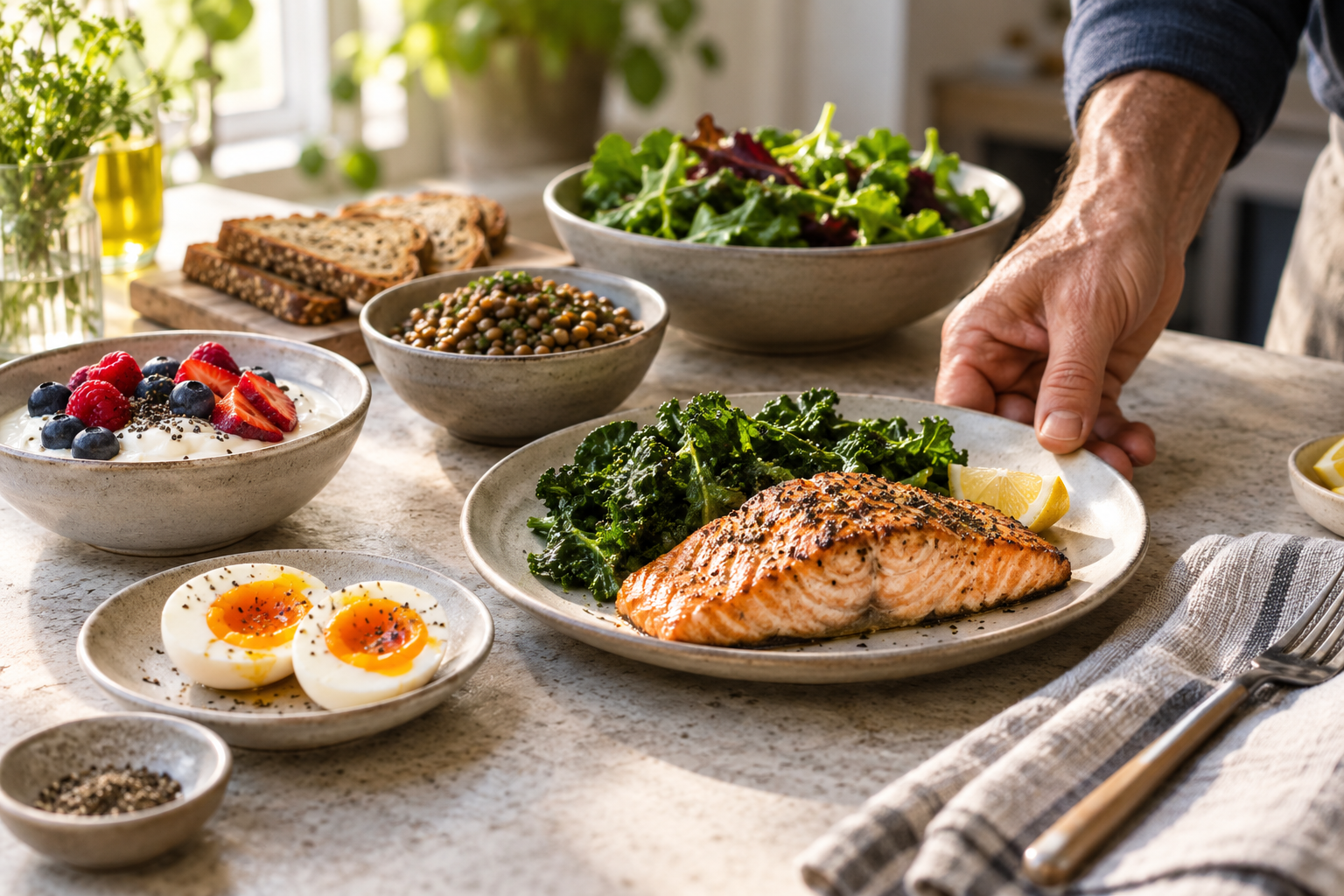
Two things change after 50. You need somewhat more protein than the general adult figure to get the same effect, and you are probably eating less of it than you think, particularly before lunchtime.
Neither problem needs a supplement to solve. Both need you to know what you are actually eating, which almost nobody does, and which takes about a week to establish.
The short version
- The general adult reference intake is 0.8 g of protein per kg of body weight per day. Two expert groups have concluded that healthy older adults do better on more.
- Anabolic resistance means the same meal produces a smaller building response than it used to.
- Breakfast is where most people lose the argument, not the day as a whole.
- You can audit a week without weighing anything.
- A supplement is a convenience for a specific problem, not a requirement.
Why the requirement changes
The reference intake most guidance is built on is 0.8 grams of protein per kilogram of body weight per day. It was set as the amount sufficient to meet the needs of nearly all healthy adults, which is not the same thing as the amount that best supports keeping muscle in your sixties and seventies.
Two expert groups have looked at older adults specifically. The PROT-AGE study group concluded that healthy older people are better served by around 1.0 to 1.2 grams per kilogram per day, with more for those who are ill or recovering.1 An ESPEN expert group reached a similar figure independently.2
In practical terms, for someone of 75 kilograms, that is roughly 75 to 90 grams a day rather than roughly 60. It is a meaningful increase but not a dramatic one, and it is reachable with food.
Anabolic resistance, in plain language
When you eat protein, your body responds by building. As people get older that response becomes blunted: the same meal produces a smaller building signal than it produced at 30. This is what researchers mean by anabolic resistance.
It is not a failure of digestion, and it is not a sign that food has stopped working. It means the amount of protein needed to get a full response at a single sitting is somewhat higher than it used to be.
The practical consequence is simple, and it is about serving size rather than food choice. A small amount of protein spread thinly is less useful than a proper serving at a meal. Which brings us to the part most people get wrong.
Distribution matters as much as the total
A typical day looks like this: almost no protein at breakfast, a moderate amount at lunch, and most of the day's protein at dinner. Toast and jam, a sandwich, then a large piece of chicken at seven in the evening.
Most people over 50 are not short of protein across the day. They are short of it at breakfast.
If the response to a meal is blunted, a breakfast with barely any protein in it produces very little, and a very large dinner does not make up the difference. Spreading the same daily total across three decent servings is the single cheapest change available.
It is worth being honest about the strength of this evidence. That even distribution produces better outcomes over months and years is supported but not settled, and study results are mixed. What is not in dispute is that moving protein from dinner to breakfast costs nothing, is easy to do and carries no downside. We think that is enough to act on, and we are labelling that as our judgement rather than as evidence.
The appetite problem
Appetite tends to decline with age. Meals get smaller, snacks replace them, and the foods that go first are usually the ones that take effort: the meat, the fish, the thing that needs cooking. Toast does not require an appetite. A piece of salmon does.
This is why so many people are surprised by their own audit. They have not changed what they think of as their diet. They have quietly changed the portions, and the protein came out first.
Cost, cooking for one, dental problems and medication side effects all push the same way. If any of those apply to you, the fix is that specific problem rather than a general resolution to eat more protein.
What a decent day actually looks like
Figures below are rounded from standard food composition tables and are close enough for planning. You do not need to memorise them. You need to recognise which of your meals has nothing on this list in it.
Breakfast, the meal to fix first
Two eggs on rye is around 13 grams. A bowl of thick Greek yoghurt is around 15 to 20. Porridge made with milk rather than water adds around 7. Cheese on the toast rather than jam adds around 10. Any of these turns a breakfast contributing almost nothing into one contributing a genuine share of the day.
Lunch, usually salvageable
A tin of tuna is around 25 to 30 grams. Two eggs in a salad, around 13. A tub of cottage cheese, around 20. Lentil soup with a piece of bread and cheese, around 20 across the plate. The common failure at lunch is a sandwich with a thin filling, and the fix is a thicker one.
Dinner, generally fine
A palm-sized piece of chicken, fish or meat is roughly 25 to 35 grams. Most people are already doing this. If your dinner is the only meal in your day carrying protein, the answer is not a bigger dinner.
None of this is complicated cooking, which is rather the point. When we built The Strong Table, the constraint we set ourselves was that every recipe had to be something you would make on a Tuesday when you did not especially feel like cooking. Recipes you admire and never make do not change anyone's protein intake.
How to audit a week without weighing anything
Weighing food is accurate and almost nobody sustains it. This is less accurate and you will actually finish it.
- For seven days, write down only the protein foods. Meat, fish, eggs, dairy, pulses, tofu, nuts. Ignore everything else. One line per meal on your phone.
- Note the rough size. Palm-sized, an egg, a tub, a glass. No scales, no apps.
- At the end of the week, count blanks. How many breakfasts had nothing on the list? How many lunches?
- Fix the most frequent blank. Not all of them. One meal, changed permanently, beats a whole diet changed for nine days.
- Repeat a month later to check the change held.
The number of blank meals is more useful than any gram total you could calculate, because it points at something you can act on tomorrow morning.
What this does not do
Eating more protein does not build muscle on its own. Muscle is built by asking it to do work and then supplying the material to repair it. Protein without resistance training supplies material for a repair job nobody ordered.
Protein is not a treatment for age-related muscle loss, and adequate intake helps maintain what you have rather than restoring what has gone. Anyone selling you the stronger version of that claim is selling you something.
More is not better without limit. The expert figures above are a target, not a floor to be exceeded as far as possible, and there is no benefit established for pushing far beyond them in healthy older adults.
And this article is general guidance. If you have kidney disease or any condition where protein intake is medically managed, these figures may be actively wrong for you, and your doctor's advice replaces them.
When a supplement is a convenience rather than a necessity
A protein or amino acid supplement solves one problem: getting protein into a person who is not getting it from food. That is a real problem for some people and no problem at all for others.
It is a reasonable convenience if your appetite is genuinely poor, if one specific meal has resisted every attempt to fix it with food, if chewing or swallowing is difficult, or if you are away from a kitchen for long stretches. It is not a requirement, and it is not superior to food for anyone able to eat the food.
If you have got as far as comparing products, the difference between EAA and BCAA formulas is the thing worth understanding first, because it decides what a given product can do at all.
If food is not closing the gap and you decide an EAA product fits your situation, you can view Advanced Amino Formula on the seller's website. We would rather you spent the money on food, and we have said so in writing on a page that earns us nothing when you take that advice.
Where to start tomorrow
Add protein to breakfast. Then run the week-long audit and see whether anything else needs attention. Most people find that it does not.
Sources
- Bauer J, Biolo G, Cederholm T, et al. Evidence-based recommendations for optimal dietary protein intake in older people: a position paper from the PROT-AGE Study Group. Journal of the American Medical Directors Association, 2013. Back to text
- Deutz NEP, Bauer JM, Barazzoni R, et al. Protein intake and exercise for optimal muscle function with aging: recommendations from the ESPEN Expert Group. Clinical Nutrition, 2014. Back to text
The 0.8 g/kg reference intake is the general adult figure from the Dietary Reference Intakes. Sources were last reviewed on 9 September 2026.
This article is for general education and is not medical advice. If you have a medical condition, are pregnant or nursing, or take prescription medication, speak to your doctor before changing your diet or starting any supplement.
These statements have not been evaluated by the Food and Drug Administration. This product is not intended to diagnose, treat, cure or prevent any disease.